

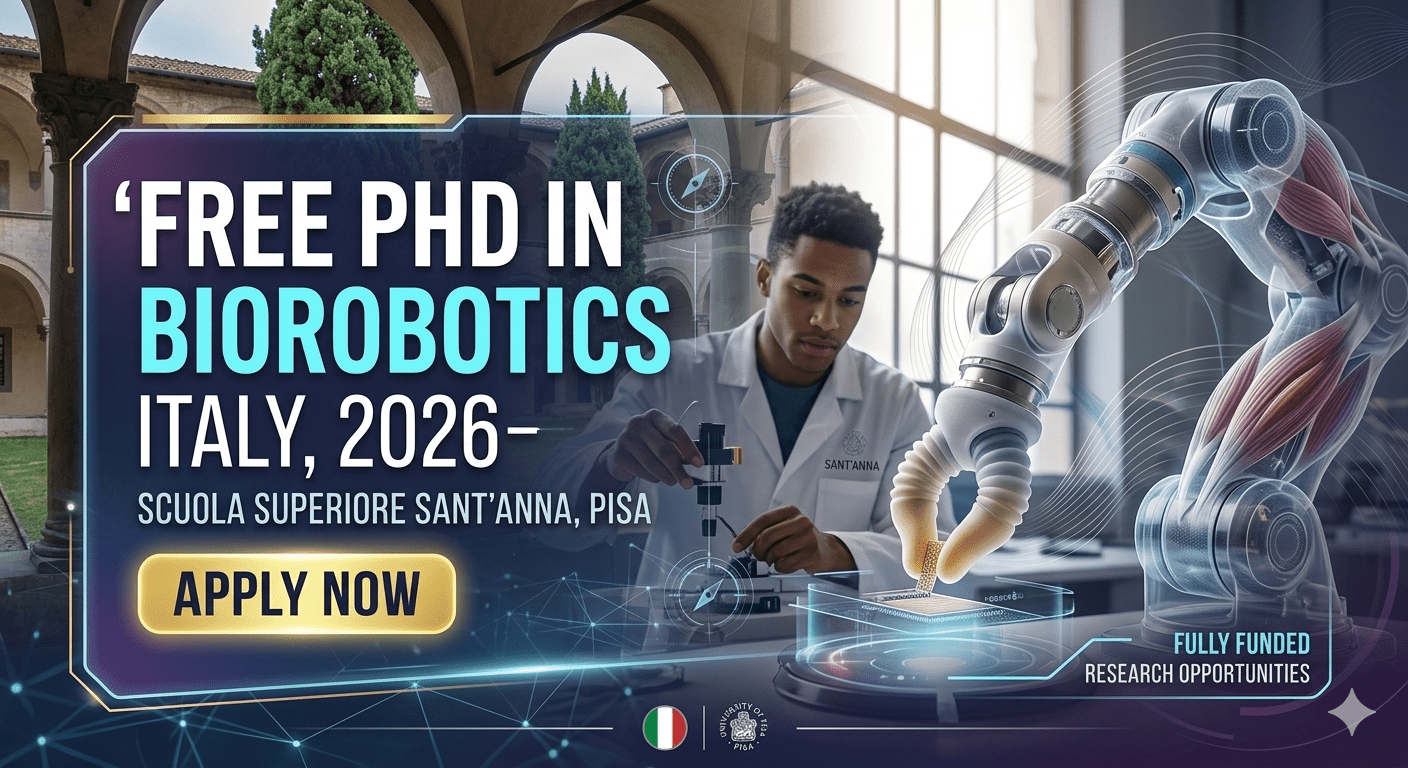
The Sant’Anna School of Advanced Studies has announced applications for the PhD in BioRobotics 2026–2027, an internationally recognized doctoral program designed to train the next generation of researchers and innovators in robotics and biomedical engineering.
With over 100 doctoral students enrolled and around 30 new students joining each year, the BioRobotics PhD program is considered one of the largest doctoral schools in robotics and biomedical engineering worldwide. The program offers a dynamic and multidisciplinary research environment where students work on innovative technologies inspired by biological systems and applied to real-world challenges.
The three-year doctoral program combines advanced academic training with cutting-edge research in well-equipped laboratories. Students collaborate with international experts and contribute to the development of next-generation robotic technologies for medical, industrial, and environmental applications.
About BioRobotics
BioRobotics is a rapidly growing interdisciplinary field that integrates concepts from robotics, bioengineering, biomimetics, and biomedical engineering. Researchers in this field design and develop intelligent machines inspired by biological systems or applied to biological and medical problems.
The PhD program encourages doctoral candidates to explore research that is technologically advanced and socially responsible, focusing on sustainability, ethical innovation, and real-world impact.
Visiting Scholar Position in Antwerp, Belgium Apply now
Students in the program work on research projects that involve:
- Bio-inspired robotic systems
- Medical robotics and microrobotics
- Biomedical devices and technologies
- Smart robotic machines and control systems
- Microfabrication and magnetic technologies
These research activities are conducted in state-of-the-art laboratories under the guidance of internationally recognized faculty members.
Program Structure BioRobotics
The PhD program follows the European Credit Transfer System (ECTS) structure. During the three-year program, doctoral students must complete:
- 20 ECTS credits through internal and external courses, summer schools, and project work
- 160 ECTS credits through research activities
The curriculum provides strong training in robotics, biomedical engineering, biomimetics, and advanced technological innovation.
By the end of the program, graduates will possess:
- Strong scientific and engineering knowledge
- Advanced research and analytical skills
- The ability to design and lead independent research projects
- Entrepreneurial and innovation capabilities
Scholarships and Benefits of BioRobotics
Students admitted to the BioRobotics PhD program receive a fully funded scholarship for three years, which is renewed annually based on academic progress.
The funding package includes several additional benefits such as:
- Financial support for the entire three-year doctoral program
- Research funding for projects and learning activities
- A personal fund for research and training
- Funding support for international research stays abroad
- Free meals at the university canteen (approximately one meal per day)
- Possible accommodation support depending on funding availability
Importantly, there are no application fees and no tuition fees required for this doctoral program.
Admission Requirements for BioRobotics
To be eligible for the PhD in BioRobotics, applicants must meet the following requirements:
- Hold a Master of Science (MSc) degree or equivalent qualification
- Students currently completing their master’s degree may apply if they graduate before 30 September
- Successfully pass the PhD entrance examination, which includes evaluation based on ranking criteria defined in the official call
- OFFICIAL SITE
Candidates with backgrounds in robotics, biomedical engineering, mechanical engineering, bioengineering, or related disciplines are encouraged to apply.
Research Opportunity in Medical Microrobotics
As part of the doctoral program, students can join research projects in the Medical Microrobotics Lab, where scientists develop innovative technologies for medical applications.
Some positions are supported through the European Research Council-funded I-BOT project, which focuses on advanced microrobotic systems and their applications in medicine.
Research areas include:
- Microrobotics
- Magnetism and magnetic control
- Microfabrication technologies
- Advanced robotic systems for healthcare
This provides students with the opportunity to contribute to cutting-edge medical technology research that may shape the future of healthcare.
Career Opportunities
Graduates of the BioRobotics PhD program benefit from an excellent employment rate, with nearly 100% employment shortly after graduation.
Alumni have secured academic and research positions at globally recognized institutions such as:
- Harvard University
- Stanford University
- Boston University
- ETH Zurich
- École Polytechnique Fédérale de Lausanne
Many graduates also work in high-tech industries, robotics companies, and technology startups worldwide.
Application Deadline
Students interested in applying should submit their application before the deadline.
📅 Application Deadline: 15 May 2026 (12:00 PM CEST)

Helen Oesha holds a Doctorate in Entrepreneurship and is a dedicated advocate for youth empowerment through education. Since 2021, she has been guiding students toward scholarships and international opportunities, making higher education more accessible worldwide. Oesha platform is widely regarded as a leading source for discovering global opportunities. Having personally experienced the challenges and success of funded doctoral studies, she is passionate about bridging the gap between ambition and access, helping students realize their dreams and reach their highest potential. this helen oesha remove and write Azhar ul Haq Wahid PhD in journalism from university of complutense Madrid,Spain Journalist write accodingly