

Applications are invited for an exciting PhD studentship at the prestigious EaStCHEM School of Chemistry, University of St Andrews, United Kingdom. This doctoral research project is being offered through a collaborative partnership between the University of St Andrews and BASF, one of the world’s largest chemical companies headquartered in Ludwigshafen, Germany.
The project focuses on surface science and heterogeneous catalysis, providing an outstanding opportunity for highly motivated students interested in chemistry, materials science, catalysis, spectroscopy, and advanced characterization techniques.
PhD Researcher – Sustainability & Life Cycle Assessment
This PhD position will allow the successful candidate to work with leading researchers from academia and industry while gaining access to world-class research facilities and state-of-the-art instrumentation.
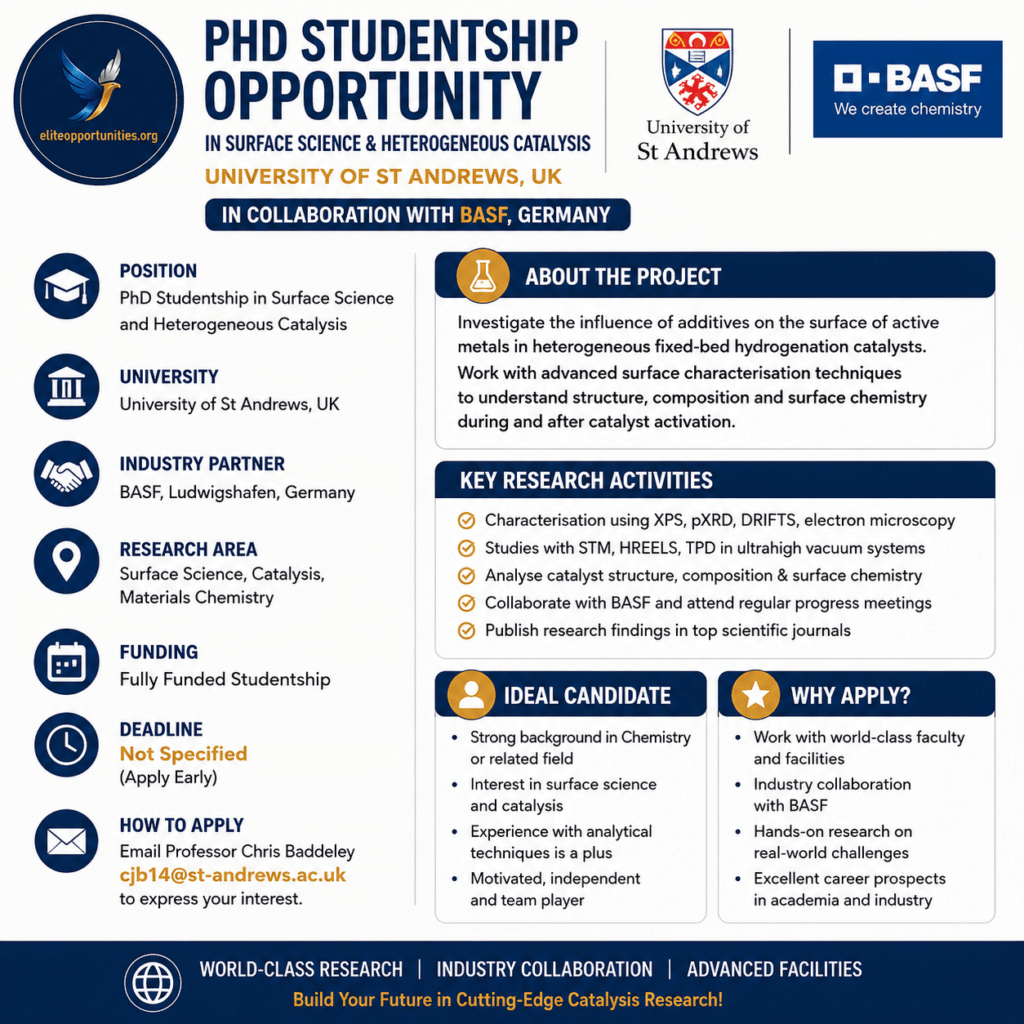
Opportunity Overview
Position: PhD Studentship in Surface Science and Heterogeneous Catalysis
University: University of St Andrews
School: EaStCHEM School of Chemistry
Industry Partner: BASF, Germany
Location: St Andrews, Scotland, United Kingdom
Research Area: Surface Science, Catalysis, Materials Chemistry
Study Level: PhD
Funding: Fully Funded Studentship
Application Method: Contact Supervisor Directly
About the Research Project
Hydrogenation catalysts are among the most important industrial catalysts used in chemical manufacturing. Their performance is often influenced by the presence of additives that modify catalyst structure, composition, and surface chemistry.
The objective of this PhD project is to investigate how additives affect the surface properties of active metals in heterogeneous fixed-bed hydrogenation catalysts.
Understanding these interactions is essential for improving catalyst efficiency, selectivity, stability, and industrial performance.
The successful PhD student will conduct detailed investigations into catalyst activation processes and surface transformations using advanced analytical techniques.
Research findings from this project could contribute significantly to the development of next-generation industrial catalysts used by BASF and other global chemical manufacturers.
Research Focus Areas
The project will involve:
- Surface characterization of catalyst materials
- Investigation of catalyst activation mechanisms
- Analysis of catalyst composition and structure
- Study of additive-metal interactions
- Surface chemistry investigations
- Evaluation of catalytic material performance
- Industrial catalyst development research
The research combines fundamental surface science with real-world industrial applications, making it highly relevant for both academic and industrial careers.
Advanced Research Facilities
The University of St Andrews offers exceptional research infrastructure for chemistry and materials science research.
Students will have access to:
Electron Microscopy Facilities
Advanced electron microscopy instruments for studying catalyst morphology and structure at microscopic and nanoscale levels.
X-ray Diffraction Facilities
- Powder X-ray Diffraction (pXRD)
- Single Crystal X-ray Diffraction
These techniques help determine crystal structures and phase compositions of catalyst materials.
Nuclear Magnetic Resonance (NMR)
- Solution-state NMR
- Solid-state NMR
Used for understanding structural and chemical properties of materials.
Thermal Analysis
Advanced thermal characterization systems for investigating catalyst stability and activation behavior.
Mass Spectrometry
State-of-the-art mass spectrometry instrumentation for chemical characterization.
Surface Analysis Facilities
Specialized equipment for detailed surface investigations of catalytic materials.
Key Analytical Techniques
The project will primarily focus on:
X-ray Photoelectron Spectroscopy (XPS)
XPS will serve as the primary analytical tool for investigating:
- Surface composition
- Chemical states
- Catalyst activation
- Surface modifications
- Additive interactions
In Situ Powder X-ray Diffraction (pXRD)
Used to monitor structural changes occurring during catalyst activation and operation.
Electron Microscopy
Provides detailed imaging of catalyst surfaces and nanostructures.
Diffuse Reflectance Infrared Fourier Transform Spectroscopy (DRIFTS)
Used to investigate surface species and catalytic reaction intermediates.
Surface Science Research Facilities
In addition to conventional characterization techniques, the Surface Science Group operates several advanced ultrahigh vacuum (UHV) systems.
These facilities support cutting-edge studies on model heterogeneous catalytic systems.
Available techniques include:
Scanning Tunneling Microscopy (STM)
STM enables atomic-scale visualization of catalyst surfaces and surface reactions.
High Resolution Electron Energy Loss Spectroscopy (HREELS)
Used to study molecular adsorption and vibrational properties on surfaces.
Temperature Programmed Desorption (TPD)
Provides insights into adsorption strength and surface interactions.
These powerful tools allow researchers to understand catalytic processes at the molecular and atomic levels.
Industry Collaboration with BASF
A major highlight of this studentship is its close collaboration with BASF.
Benefits include:
- Regular meetings with BASF researchers
- Exposure to industrial research challenges
- Access to industry expertise
- Networking opportunities
- Enhanced career prospects
- Potential future employment opportunities
The student will gain valuable experience working at the interface of academic research and industrial innovation.
Candidate Profile
Applicants should possess:
Essential Requirements
- Strong academic background in Chemistry or related discipline
- Interest in catalysis and surface science
- Motivation for research
- Excellent communication skills
- Ability to work independently and collaboratively
Preferred Background
Candidates with experience in:
- Surface characterization
- Materials chemistry
- Catalysis
- Physical chemistry
- Spectroscopy
- Nanomaterials
- Surface science
will be particularly competitive.
Why Choose the University of St Andrews?
The University of St Andrews is one of the world’s leading research-intensive universities and consistently ranks among the top institutions in the United Kingdom.
Benefits include:
- Internationally recognized degree
- World-class research environment
- Modern research facilities
- Strong industry partnerships
- Expert academic supervision
- Excellent graduate employability
Career Opportunities
Graduates from this PhD program may pursue careers in:
- Industrial R&D
- Chemical Manufacturing
- Catalysis Research
- Materials Science
- Surface Science
- Energy Technologies
- Academic Research
- Government Research Laboratories
The combination of advanced technical training and industry collaboration provides excellent career preparation.
How to Apply
Interested candidates should contact:
Professor Chris Baddeley
Email: cjb14@st-andrews.ac.uk
Prospective applicants are encouraged to contact Professor Baddeley directly to discuss the project and application process.
Further information about postgraduate research opportunities at the EaStCHEM School of Chemistry can be found through the University of St Andrews postgraduate research pages.
Final Thoughts
This PhD studentship represents an exceptional opportunity for students interested in surface science, catalysis, and industrial chemistry. By combining world-class academic research at the University of St Andrews with industrial collaboration from BASF, the project offers a unique platform for scientific discovery and professional development.
Researchers seeking to contribute to the advancement of heterogeneous catalysis while gaining valuable industry exposure are strongly encouraged to apply.
UK Fully funded PhD in Chemistry 2026 Apply now
- Where is this PhD position based?The PhD studentship is based at the University of St Andrews, Scotland, United Kingdom.
- Who is collaborating on this research project?The project is a collaboration between the University of St Andrews and BASF, Germany.
- What is the main research focus?The project investigates how additives influence the surface chemistry and performance of heterogeneous hydrogenation catalysts.
- What analytical techniques will be used?Techniques include XPS, pXRD, DRIFTS, STM, HREELS, TPD, electron microscopy, NMR, and X-ray diffraction.
- How can I apply?Interested applicants should email Professor Chris Baddeley at cjb14@st-andrews.ac.uk to express their interest and obtain application details.

Helen Oesha holds a Doctorate in Entrepreneurship and is a dedicated advocate for youth empowerment through education. Since 2021, she has been guiding students toward scholarships and international opportunities, making higher education more accessible worldwide. Oesha platform is widely regarded as a leading source for discovering global opportunities. Having personally experienced the challenges and success of funded doctoral studies, she is passionate about bridging the gap between ambition and access, helping students realize their dreams and reach their highest potential. this helen oesha remove and write Azhar ul Haq Wahid PhD in journalism from university of complutense Madrid,Spain Journalist write accodingly