

AI Tools
Artificial Intelligence (AI) is rapidly transforming the way researchers write, edit, and organize academic work. From improving grammar to helping structure complex ideas, AI tools are now widely used by students and scholars preparing theses, dissertations, journal articles, and research reports. However, many researchers are still confused about one critical question: Which AI tools are acceptable in academic writing, and which ones could lead to rejection of your manuscript?
Understanding the difference is extremely important because academic publishing follows strict research ethics and transparency guidelines. Many journals now have clear policies regarding AI use in manuscript preparation. While some tools are accepted for language improvement and research organization, others can create ethical concerns if used incorrectly.
Below is a simple guide to help researchers understand which AI tools are generally accepted and which ones should be used with caution.
PhD Positions in Germany 2026 Research Program: Apply now
AI Tools Generally Accepted by Academic Journals
Many journals allow AI tools that improve language quality but do not generate original research content. These tools are considered supportive assistants rather than authors.
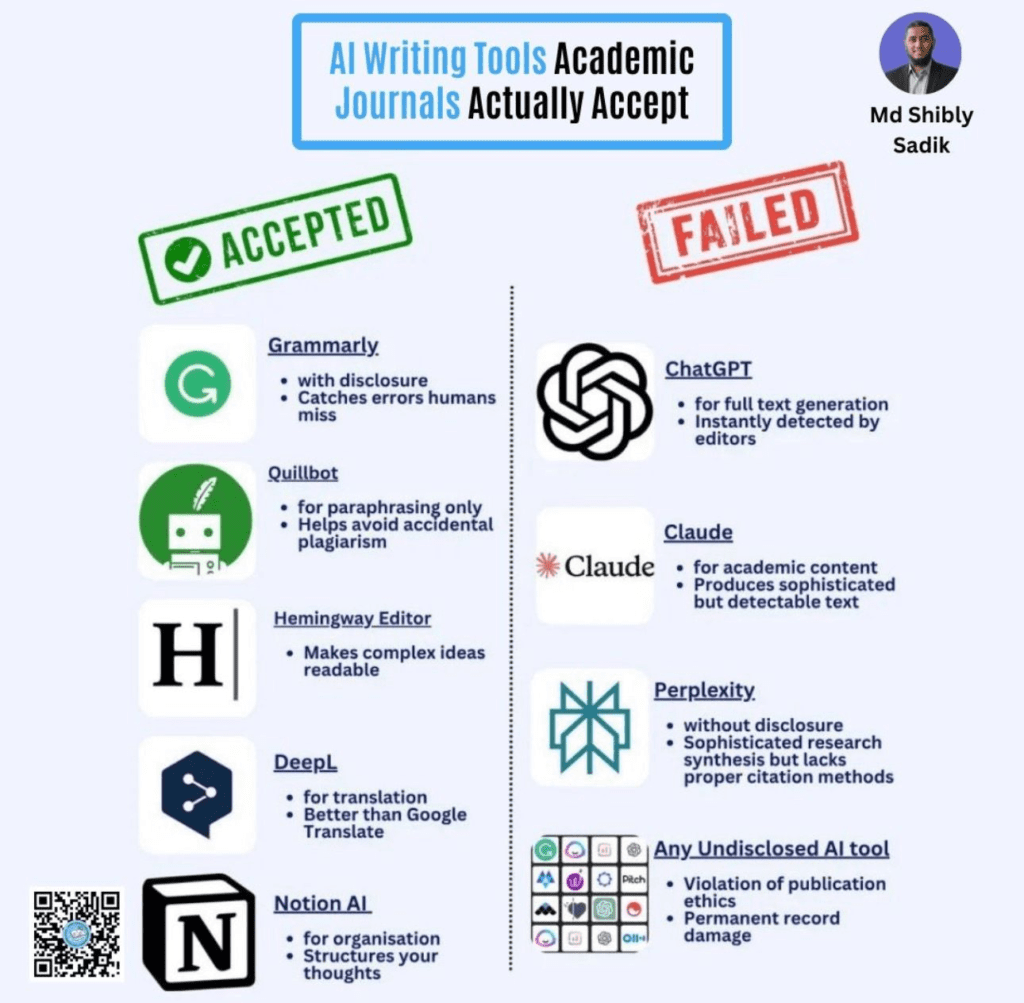
✅ AI Tools Generally Accepted (With Proper Disclosure)
✔ Grammarly – Used for grammar correction, clarity, and proofreading.
Most journals accept it because it only improves language quality.
✔ QuillBot – Helpful for light paraphrasing to avoid accidental plagiarism.
However, it should not be used to rewrite entire sections.
✔ Hemingway Editor – Improves readability and simplifies complex academic sentences.
✔ DeepL Translator – One of the most accurate tools for academic translation, especially for non-native English researchers.
✔ Notion AI – Useful for organizing notes, summarizing literature, and structuring research ideas.
Grammarly is one of the most widely accepted tools in academic writing. It helps correct grammar, spelling, punctuation, and sentence clarity. Since it only improves the language of the text rather than generating new ideas, most journals accept its use as long as the researcher remains the original author of the content.
Another commonly used tool is QuillBot, which helps with light paraphrasing. Researchers often use it to rephrase sentences and avoid unintentional plagiarism. However, it should be used carefully. Journals generally discourage rewriting entire sections of research papers with paraphrasing tools. The goal should be improving wording, not replacing the author’s intellectual work.
Hemingway Editor is another helpful tool for academic writers. Academic papers often become complex and difficult to read. Hemingway helps simplify sentences, remove unnecessary words, and improve readability. This makes research papers easier for reviewers and readers to understand.
For researchers who are not native English speakers, DeepL Translator has become a popular option for academic translation. It provides more accurate translations compared to many other tools and helps researchers convert their work into professional academic English.
Another useful tool is Notion AI, which many researchers use for organizing research notes, summarizing articles, managing references, and planning research structures. It helps researchers stay organized during the writing process without generating the core content of the paper.
When using any of these tools, researchers should always remember one important rule: transparency. Many journals recommend mentioning AI assistance in the acknowledgements or methods section to maintain ethical integrity.
AI Tools That Can Lead to Paper Rejection
While some AI tools are acceptable, others can create serious problems in academic publishing.
🚫 AI Tools That Can Get Your Paper Rejected
❌ ChatGPT / Claude – Using them for full-text generation of research papers may violate many journal policies.
❌ Perplexity AI – Good for quick research summaries but not reliable for citation-based academic writing.
❌ Undisclosed AI Use – Not mentioning AI assistance in your manuscript can lead to paper rejection, ethical violations, or blacklisting.
Using tools like ChatGPT or Claude to generate large portions of a research paper can violate journal policies. These systems can produce well-written text, but they may also generate inaccurate information, fabricated citations, or content that lacks genuine academic reasoning. Because of these risks, many journals discourage or prohibit the use of AI for full-text generation.
Another tool researchers should use cautiously is Perplexity AI. Although it can help summarize research topics and provide quick insights, its references are not always reliable or verifiable. Academic research requires precise citations and evidence-based writing, which means relying heavily on such tools can weaken the credibility of a manuscript.
Perhaps the most serious mistake a researcher can make is using AI tools without disclosure. Many journals now require authors to clearly state whether AI tools were used during manuscript preparation. Failing to disclose AI assistance can be considered a violation of publication ethics. In some cases, this can result in paper rejection, withdrawal of published articles, or even long-term damage to a researcher’s reputation.
🎓 Final Advice for Researchers
AI is not banned in research writing — misuse is the real problem.
✔ Use AI for grammar, clarity, and organization
✔ Avoid using AI as a ghostwriter for research content
✔ Always disclose AI usage in your manuscript
Transparency and academic integrity are the foundation of credible research publishing.
📚 FREE Websites to Download PhD Theses
- Open Access Theses & Dissertations (OATD) – https://oatd.org
- OpenThesis – http://www.openthesis.org
- DART-Europe E-theses Portal – https://lnkd.in/d4SUFCTX
- ProQuest Dissertations & Theses – https://www.proquest.com
- MIT Theses – https://lnkd.in/dMs-PuYs
- Networked Digital Library of Theses & Dissertations – http://www.ndltd.org
- Caltech Theses – https://lnkd.in/dZ6f8T5J
- British Library EThOS – https://www.bl.uk
- OhioLINK Electronic Theses & Dissertations Center – https://etd.ohiolink.edu
- Harvard DASH Repository – https://dash.harvard.edu
These platforms provide thousands of free research theses and dissertations for students and researchers worldwide..
Courtesy: Shibly
Follow Md Shibly Sadik for more

Helen Oesha holds a Doctorate in Entrepreneurship and is a dedicated advocate for youth empowerment through education. Since 2021, she has been guiding students toward scholarships and international opportunities, making higher education more accessible worldwide. Oesha platform is widely regarded as a leading source for discovering global opportunities. Having personally experienced the challenges and success of funded doctoral studies, she is passionate about bridging the gap between ambition and access, helping students realize their dreams and reach their highest potential.