

Applications are now open for an exciting PhD Studentship in Fungal Conservation jointly offered by the University of Reading and Royal Botanic Gardens, Kew (RBG Kew). This fully funded doctoral project provides a unique opportunity to contribute to the conservation of threatened fungal species in the United Kingdom while gaining advanced training in biodiversity monitoring, molecular ecology, bioinformatics, and fungal conservation science.
The project, titled “Predicting the Future of Threatened Mycorrhizal Fungi in the UK,” focuses on understanding the distribution, ecology, and conservation of rare and threatened ectomycorrhizal fungi. Successful candidates will work alongside leading researchers from both institutions and participate in fieldwork across protected sites in England, laboratory-based fungal research, and conservation-focused ecological modeling.
Overview of the PhD Studentship
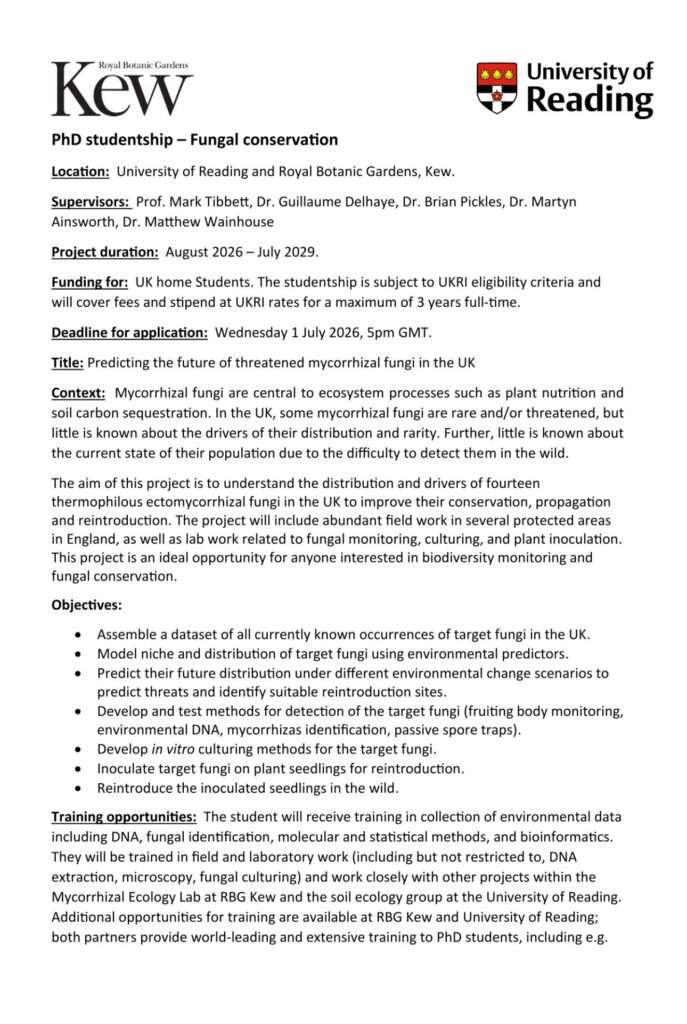
Host Institutions: University of Reading & Royal Botanic Gardens, Kew
Location: Reading and Kew, United Kingdom
Project Title: Predicting the Future of Threatened Mycorrhizal Fungi in the UK
Project Duration: August 2026 – July 2029
Funding: Fully Funded (UK Home Students)
Application Deadline: 1 July 2026, 5:00 PM GMT
Study Level: PhD
Supervisory Team
The successful candidate will be supervised by a distinguished team of experts in fungal ecology, biodiversity conservation, and ecosystem science:
- Professor Mark Tibbett
- Dr Guillaume Delhaye
- Dr Brian Pickles
- Dr Martyn Ainsworth
- Dr Matthew Wainhouse
This interdisciplinary supervisory team brings together expertise from both academia and one of the world’s most respected botanical research institutions.
About the Research Project
Mycorrhizal fungi play a critical role in ecosystem functioning. They form symbiotic relationships with plant roots, helping plants absorb nutrients and water while contributing significantly to soil carbon sequestration and biodiversity maintenance.
Despite their ecological importance, many mycorrhizal fungi in the UK are considered rare, threatened, or poorly understood. Their hidden underground lifestyles make them difficult to monitor, resulting in significant knowledge gaps regarding their distribution, population status, and conservation requirements.
This PhD project seeks to address these challenges by investigating fourteen thermophilous ectomycorrhizal fungal species found in the UK. The research will contribute to conservation planning, habitat restoration, species propagation, and potential reintroduction efforts.
The project combines ecological fieldwork, laboratory experimentation, molecular biology techniques, and predictive modeling to create a comprehensive understanding of these threatened fungal species.
Research Objectives
The PhD student will undertake several important research activities, including:
1. Building a National Fungal Occurrence Database
The project will compile and assemble a comprehensive dataset of all currently known occurrences of the target fungal species across the UK.
This database will provide an essential foundation for future conservation planning and ecological analysis.
2. Modeling Species Distribution
Using environmental predictors and ecological modeling techniques, the student will examine habitat preferences and determine factors influencing fungal distribution patterns.
These models will help identify suitable habitats and areas of conservation importance.
3. Predicting Future Distribution Under Environmental Change
Climate change and habitat alteration pose major threats to biodiversity.
The project will develop predictive models to assess how future environmental changes may impact the distribution and survival of target fungal species.
These predictions will help identify priority conservation areas and potential reintroduction sites.
4. Developing Detection and Monitoring Methods
A major component of the research involves improving methods for detecting and monitoring fungal populations.
The student will evaluate and develop approaches such as:
- Fruiting body monitoring
- Environmental DNA (eDNA) analysis
- Mycorrhizal identification techniques
- Passive spore trapping methods
These tools are increasingly important for modern biodiversity conservation and ecological monitoring.
5. Developing In Vitro Culturing Techniques
The project includes laboratory research focused on developing fungal culturing methods.
Successfully cultivating threatened fungi in controlled environments could significantly improve conservation and restoration efforts.
6. Plant Inoculation and Reintroduction
The research will also explore methods for inoculating plant seedlings with target fungal species and subsequently reintroducing these inoculated plants into suitable natural habitats.
This innovative approach may support future conservation and habitat restoration programs.
Training and Professional Development
One of the major strengths of this PhD opportunity is the extensive training provided by both institutions.
The successful candidate will receive advanced training in:
Field-Based Skills
- Biodiversity monitoring
- Ecological surveying
- Environmental data collection
- Protected area research
Molecular Biology Techniques
- DNA extraction
- Environmental DNA analysis
- Molecular fungal identification
- Genetic monitoring methods
Laboratory Research
- Fungal culturing
- Microscopy
- Mycorrhizal identification
- Plant-fungi interaction studies
Data Science and Bioinformatics
- Statistical analysis
- Ecological modeling
- Species distribution modeling
- Bioinformatics workflows
Students will also have opportunities to collaborate with researchers in the Mycorrhizal Ecology Lab at RBG Kew and the Soil Ecology Group at the University of Reading.
Why Study at Royal Botanic Gardens, Kew?
Royal Botanic Gardens, Kew is internationally recognized as one of the world’s leading institutions for plant and fungal science.
Researchers at Kew contribute to global biodiversity conservation, taxonomy, ecosystem restoration, and environmental sustainability.
As a PhD student, you will gain access to:
- World-class fungal collections
- Advanced laboratory facilities
- International research networks
- Leading conservation scientists
- Unique biodiversity datasets
Why Study at the University of Reading?
The University of Reading is a globally respected institution known for excellence in environmental science, ecology, agriculture, and biodiversity research.
The university offers:
- Outstanding research infrastructure
- Interdisciplinary collaborations
- Advanced ecological research facilities
- Strong links with conservation organizations
- Comprehensive doctoral training programs
Funding Information
The studentship is available to UK Home Students and is subject to UK Research and Innovation (UKRI) eligibility criteria.
Funding includes:
✅ Full tuition fee coverage
✅ UKRI standard stipend
✅ Research training support
✅ Access to laboratory and fieldwork facilities
✅ Professional development opportunities
✅ Collaboration with internationally recognized researchers
Ideal Candidate Profile
The project is particularly suitable for candidates interested in:
- Fungal ecology
- Conservation biology
- Biodiversity monitoring
- Mycology
- Ecosystem restoration
- Environmental DNA research
- Bioinformatics
- Plant-fungal interactions
Applicants with backgrounds in biology, ecology, environmental science, conservation science, mycology, forestry, or related disciplines are encouraged to apply.
The successful candidate should demonstrate:
- Strong interest in fungal conservation
- Enthusiasm for field and laboratory research
- Good analytical and communication skills
- Interest in ecological modeling and biodiversity science
Application Deadline
📅 Deadline: Wednesday, 1 July 2026
⏰ Time: 5:00 PM GMT
Early applications are strongly encouraged.
Frequently Asked Questions (FAQs)
What is the PhD Studentship in Fungal Conservation about?
The PhD Studentship in Fungal Conservation focuses on understanding and protecting threatened mycorrhizal fungi in the UK through ecological monitoring, species distribution modeling, fungal culturing, and conservation research.
Who can apply for the Fungal Conservation PhD Studentship?
The studentship is primarily funded for UK Home Students who meet UKRI eligibility requirements and have relevant academic backgrounds in ecology, biology, environmental science, mycology, or related disciplines.
Is the University of Reading Fungal Conservation PhD fully funded?
Yes. The studentship covers tuition fees and provides a stipend at UKRI rates for up to three years of full-time study.
What research skills will students gain during the Fungal Conservation PhD?
Students will gain expertise in biodiversity monitoring, fungal identification, environmental DNA analysis, ecological modeling, bioinformatics, fungal culturing, and conservation science.
Where will the PhD research be conducted?
Research will be conducted at both the University of Reading and the Royal Botanic Gardens, Kew, including fieldwork in protected areas across England.
What is the application deadline for the Fungal Conservation PhD Studentship?
Applications must be submitted by 1 July 2026 at 5:00 PM GMT.
Why are mycorrhizal fungi important for biodiversity conservation?
Mycorrhizal fungi support plant nutrition, improve ecosystem resilience, contribute to soil carbon storage, and play a vital role in maintaining healthy ecosystems and biodiversity.

Helen Oesha holds a Doctorate in Entrepreneurship and is a dedicated advocate for youth empowerment through education. Since 2021, she has been guiding students toward scholarships and international opportunities, making higher education more accessible worldwide. Oesha platform is widely regarded as a leading source for discovering global opportunities. Having personally experienced the challenges and success of funded doctoral studies, she is passionate about bridging the gap between ambition and access, helping students realize their dreams and reach their highest potential. this helen oesha remove and write Azhar ul Haq Wahid PhD in journalism from university of complutense Madrid,Spain Journalist write accodingly