


Aspiring researchers interested in statistics, causal inference, machine learning, and healthcare data science now have an exciting opportunity to pursue a fully funded PhD in Ireland. The School of Medicine at the University of Limerick is inviting applications for a prestigious four-year doctoral position focused on developing innovative statistical methods for causal inference using longitudinal electronic health records and observational healthcare data.
This fully funded PhD project will be supervised by Dr. Maurice O’Connell, Associate Professor in Medical Biostatistics, and offers the opportunity to work at the intersection of statistics, machine learning, epidemiology, and healthcare decision-making.
Postdoctoral Fellowships at Cambridge University, UK Apply now
The successful candidate will contribute to cutting-edge methodological research while gaining valuable experience working with large-scale healthcare datasets and collaborating with experts in statistics, medicine, and health data science.
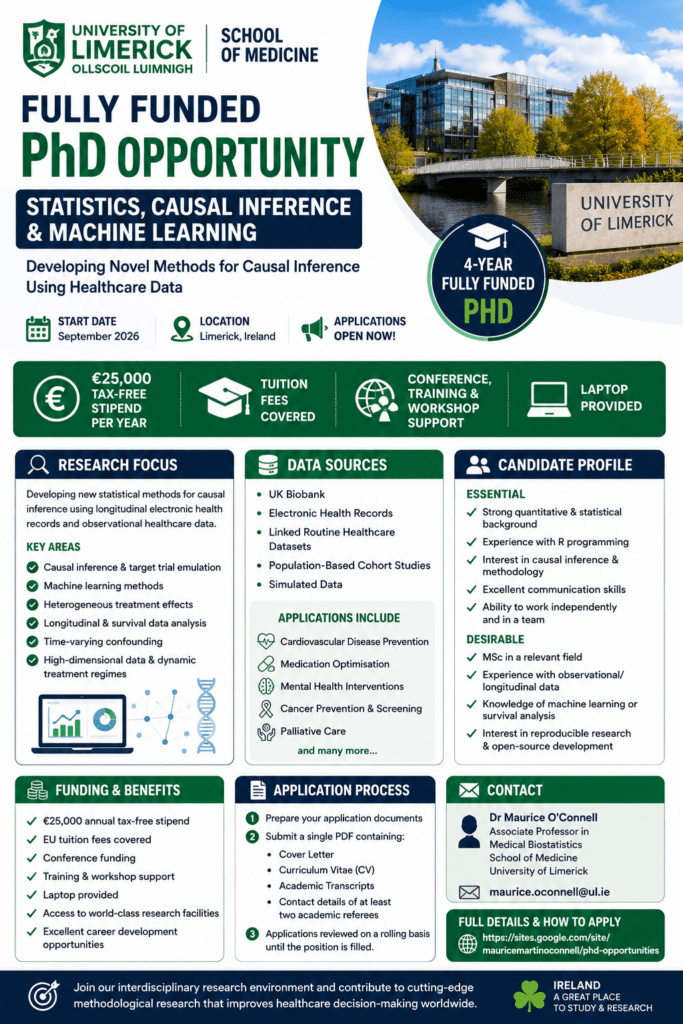
PhD Opportunity Overview
Host University: University of Limerick
Department: School of Medicine
Country: Ireland
Program Level: PhD
Funding Type: Fully Funded
Duration: 4 Years
Start Date: September 2026
Annual Stipend: €25,000 Tax-Free
Tuition Fees: Fully Covered
Additional Benefits: Laptop, conference funding, training support, workshops, and international research opportunities
About the Research Project
Modern healthcare systems generate vast amounts of patient data through electronic health records, hospital databases, and population-based cohort studies. While these datasets provide unprecedented opportunities to understand treatment effectiveness, researchers face significant challenges when estimating causal effects from observational data.
This PhD project aims to develop novel statistical methodologies capable of addressing some of the most important challenges in modern health data science.
The research will focus on causal inference techniques that allow researchers to estimate treatment effects in situations where randomized clinical trials may not be feasible or ethical.
Particular emphasis will be placed on:
- Longitudinal electronic health records
- Observational healthcare datasets
- Dynamic treatment strategies
- Time-varying confounding
- Treatment-effect heterogeneity
- Complex survival outcomes
- High-dimensional healthcare data
The project combines advanced statistical theory with practical healthcare applications, making it ideal for students who enjoy both methodological development and real-world impact.
Key Research Areas
The successful candidate will contribute to research in several exciting areas, including:
Causal Inference
Developing robust statistical methods to estimate treatment effects from observational healthcare data.
Target Trial Emulation
Designing analytical approaches that mimic randomized clinical trials using real-world healthcare datasets.
Machine Learning for Causal Inference
Integrating modern machine learning techniques with causal inference frameworks to improve treatment effect estimation.
Dynamic Treatment Regimes
Studying how treatment strategies evolve over time and impact patient outcomes.
Semiparametric Statistics
Developing efficient statistical estimators that balance flexibility with interpretability.
Longitudinal Data Analysis
Analyzing patient data collected over extended periods to identify trends and treatment responses.
Survival Analysis
Modeling time-to-event outcomes such as disease progression, hospitalization, and mortality.
Health Data Science
Applying advanced analytics to address major healthcare challenges.
Potential Application Areas
The methodologies developed during this PhD may be applied to a wide range of healthcare challenges, including:
- Medication optimization
- Polypharmacy management
- Deprescribing strategies
- Cardiovascular disease prevention
- Diabetes management
- Mental health interventions
- Cancer prevention and screening
- Clinical decision support systems
- Palliative care research
These applications provide opportunities to generate research with meaningful societal impact while advancing statistical science.
Data Sources
The project will involve working with large and internationally recognized healthcare datasets, including:
UK Biobank
One of the world’s largest biomedical databases containing extensive health and genetic information.
Electronic Health Records
Longitudinal healthcare records providing real-world evidence on patient outcomes.
Linked Healthcare Datasets
Integrated databases connecting information across healthcare systems.
Population-Based Cohort Studies
Long-term observational studies examining health outcomes across populations.
Simulated Data
Advanced simulation studies for evaluating novel statistical methods.
Funding Benefits
This PhD position offers a highly competitive funding package designed to support students throughout their doctoral studies.
Financial Support Includes:
- €25,000 annual tax-free stipend
- Full EU tuition fee coverage
- Conference funding
- Workshop and training support
- Research travel opportunities
- Laptop provided
- Access to advanced computing resources
The comprehensive funding package allows students to focus entirely on their research and professional development.
Training and Research Environment
The successful applicant will join a vibrant and interdisciplinary research environment within the School of Medicine at the University of Limerick.
Students will receive advanced training in:
- Causal inference methodology
- Statistical machine learning
- Semiparametric statistics
- Longitudinal data analysis
- Survival analysis
- Reproducible research practices
- Scientific programming in R
- Academic writing and publication
The program also encourages students to:
- Publish in leading international journals
- Present research at global conferences
- Attend summer schools and specialist workshops
- Develop open-source software tools
- Build international research collaborations
Candidate Requirements
Applicants should possess a strong quantitative background and a genuine interest in statistical methodology.
Eligible Degrees Include:
- Statistics
- Biostatistics
- Mathematics
- Applied Mathematics
- Data Science
- Computer Science
- Econometrics
- Epidemiology
- Related quantitative disciplines
Applicants should hold or expect to obtain a First Class or Upper Second Class Honours degree (or international equivalent) before September 2026.
Essential Skills
Candidates should demonstrate:
- Strong quantitative and statistical abilities
- Experience with statistical programming (preferably R)
- Interest in causal inference research
- Excellent analytical skills
- Strong written and verbal communication abilities
- Ability to work independently and collaboratively
Preferred Qualifications
The following qualifications would be advantageous:
- Master’s degree in a relevant discipline
- Experience working with observational data
- Knowledge of machine learning techniques
- Familiarity with causal inference methods
- Experience in survival analysis
- Interest in reproducible research
- Open-source software development experience
Why Choose the University of Limerick?
The University of Limerick is one of Ireland’s leading research universities and is internationally recognized for excellence in teaching, innovation, and interdisciplinary research.
Students benefit from:
- World-class research facilities
- Strong international collaborations
- Industry engagement opportunities
- Comprehensive doctoral training
- Supportive academic environment
- Career development resources
The School of Medicine provides a dynamic setting for health data science research and offers access to experts across multiple disciplines.
Application Process
Interested candidates should submit a single PDF document containing:
- Cover Letter
- Curriculum Vitae (CV)
- Academic Transcripts
- Contact Details for Two Academic Referees
Applications will be reviewed on a rolling basis until the position is filled.
Early applications are strongly encouraged.
Contact Information
Informal Enquiries
Dr Maurice O’Connell
Associate Professor in Medical Biostatistics
School of Medicine
University of Limerick
Email: maurice.oconnell@ul.ie
For complete details and application instructions, applicants should visit the official project webpage.
Final Thoughts
This fully funded PhD in Statistics, Causal Inference and Machine Learning offers an exceptional opportunity for talented students to develop advanced methodological expertise while contributing to important healthcare research challenges. With generous funding, access to large-scale health datasets, interdisciplinary supervision, and opportunities for international collaboration, the position provides an ideal environment for launching a successful research career in statistics, biostatistics, machine learning, and health data science.

Helen Oesha holds a Doctorate in Entrepreneurship and is a dedicated advocate for youth empowerment through education. Since 2021, she has been guiding students toward scholarships and international opportunities, making higher education more accessible worldwide. Oesha platform is widely regarded as a leading source for discovering global opportunities. Having personally experienced the challenges and success of funded doctoral studies, she is passionate about bridging the gap between ambition and access, helping students realize their dreams and reach their highest potential. this helen oesha remove and write Azhar ul Haq Wahid PhD in journalism from university of complutense Madrid,Spain Journalist write accodingly